

What Is AHRI Standard 700? A Guide for Refrigerant Buyers
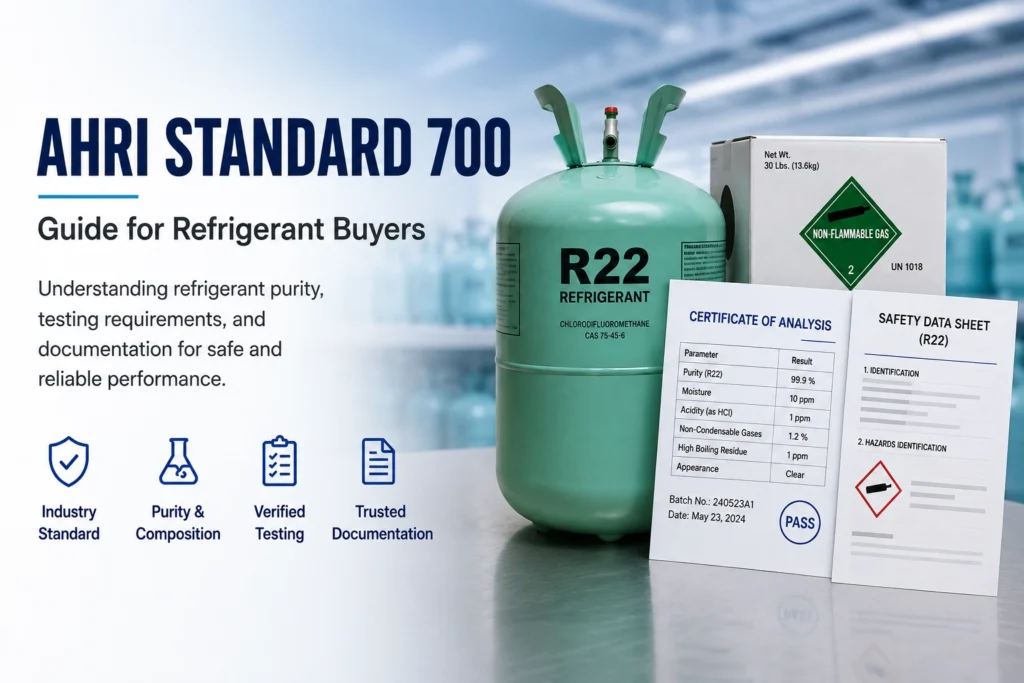
AHRI Standard 700 is an important industry reference for refrigerant purity, composition, and testing. For HVAC/R contractors, wholesalers, distributors, and commercial refrigeration buyers, understanding this standard can help when evaluating refrigerant quality and supplier documentation.
When purchasing refrigerant cylinders, price and availability are important—but they should not be the only factors buyers consider. Product quality, documentation, supplier reliability, and applicable regulatory requirements can also affect purchasing decisions.
But what exactly is AHRI Standard 700? What does it test? And what should buyers look for before ordering refrigerant cylinders?
This guide explains the basics.
What Is AHRI Standard 700?
AHRI Standard 700 — Specifications for Refrigerants is an industry standard developed by the Air-Conditioning, Heating, and Refrigeration Institute (AHRI).
The standard establishes purity specifications, composition requirements, and recognized testing methods for refrigerants used in refrigeration and air-conditioning applications. It applies to refrigerants from different sources, including new, reclaimed, and repackaged refrigerants.
For buyers, the important point is simple:
AHRI 700 provides a recognized framework for evaluating whether refrigerant meets defined purity and contaminant specifications.
For additional technical information, buyers can review the AHRI Standards & Guidelines.
Why Does AHRI 700 Matter to Refrigerant Buyers?
Refrigerant may look normal inside a cylinder, but appearance alone cannot confirm its composition or purity.
Potential quality concerns can include:
- Excessive moisture
- Acidity
- Non-condensable gases
- High-boiling residues
- Particulate or solid contamination
- Incorrect refrigerant composition
- Contamination from other refrigerants
These issues may create operational or service problems depending on the refrigerant and application.
For commercial buyers purchasing multiple cylinders, documentation and quality verification therefore become an important part of supplier evaluation.
AHRI 700 gives buyers and suppliers a common technical reference when discussing refrigerant quality.
What Does AHRI 700 Test?
The exact specifications depend on the refrigerant, but AHRI Standard 700 addresses several important quality characteristics.
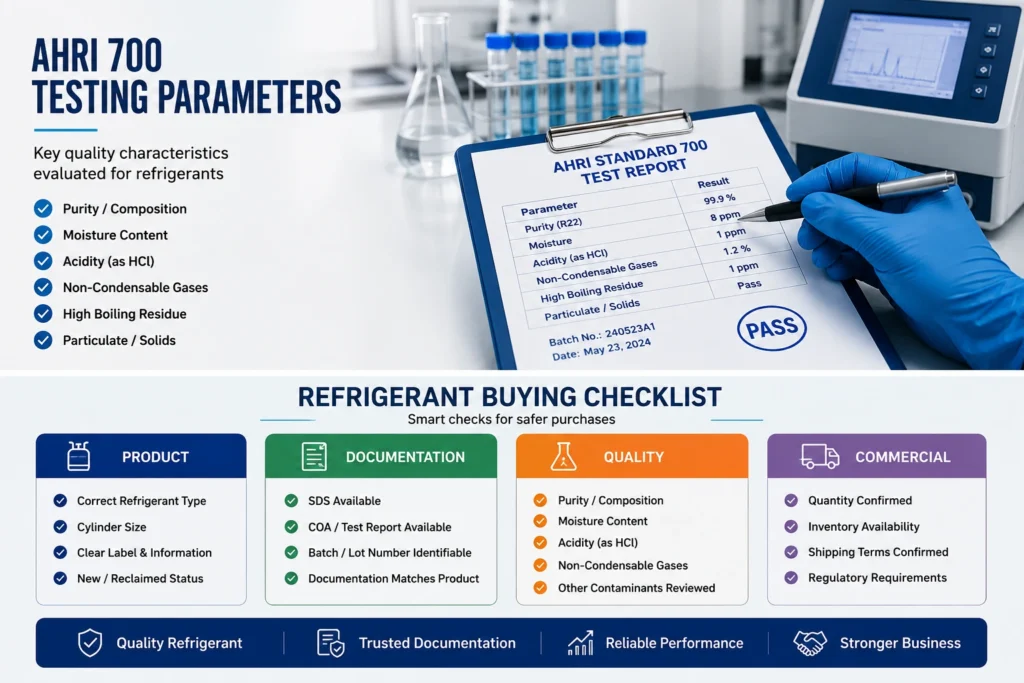
1. Refrigerant Composition
One of the first questions is whether the cylinder actually contains the correct refrigerant.
For a single-component refrigerant, testing can help verify its identity and composition.
For refrigerant blends, composition is particularly important because the proportions of the individual components must remain within applicable specifications.
2. Moisture
Excess moisture is undesirable in refrigeration and air-conditioning systems.
Moisture can contribute to system problems and may interact with other contaminants or materials inside the refrigeration circuit.
For this reason, moisture content is one of the quality characteristics considered when refrigerant is evaluated against applicable specifications.
3. Acidity
Acidity is another important refrigerant quality parameter.
Elevated acidity can indicate contamination or degradation and may present risks to refrigeration system components.
A refrigerant quality report may therefore include an acidity test result.
4. Non-Condensable Gases
Air and other non-condensable gases can enter refrigerant through improper handling, processing, evacuation, storage, or contamination.
Because these gases do not behave like the intended refrigerant during the refrigeration cycle, excessive levels can negatively affect system operation.
5. High-Boiling Residue
Oil and other high-boiling contaminants may remain in refrigerant, particularly when refrigerant has been recovered or processed.
Testing for high-boiling residue helps evaluate this type of contamination.
6. Particulates and Solids
Refrigerant should also be evaluated for unwanted particulate contamination.
Solid contaminants inside the refrigeration circuit may create reliability and service concerns.
Does “AHRI 700” Mean the Refrigerant Is AHRI Certified?
This is an important distinction for buyers.
A supplier stating that refrigerant “meets AHRI Standard 700 specifications” is not automatically the same thing as saying that the product or supplier has been independently certified by AHRI.
AHRI 700 is a technical specification standard.
Therefore, buyers should look beyond marketing language and ask what documentation supports the supplier’s quality claim.
Useful supporting information may include:
- Certificate of Analysis (COA)
- Batch or lot number
- Laboratory test results
- Refrigerant identity
- Purity or composition results
- Moisture results
- Acidity results
- Other applicable contaminant test results
The documentation should correspond as closely as possible to the actual refrigerant batch being purchased.
AHRI 700 vs COA: What Is the Difference?
AHRI 700 and a Certificate of Analysis are related, but they are not the same thing.
| AHRI Standard 700 | Certificate of Analysis (COA) |
|---|---|
| Establishes refrigerant specifications | Reports results for a product or batch |
| Defines quality parameters | Shows measured test results |
| Provides recognized testing requirements | Provides evidence from testing |
| Industry standard | Product/batch documentation |
A simple way to understand the relationship is:
AHRI 700 tells you what specifications matter; the COA can help show how a particular batch performed against applicable specifications.
For a more detailed explanation, read our Why SDS and COA Matter When Buying Refrigerant Cylinders guide.
Is an SDS the Same as AHRI 700 Testing?
No.
A Safety Data Sheet (SDS) primarily provides information related to chemical identification, hazards, handling, storage, exposure controls, and emergency measures.
An SDS is important documentation, but it should not normally be treated as proof that a particular refrigerant batch meets specific purity requirements.
A simple way for buyers to understand the difference is:
SDS → Safety and handling information
COA / Test Documentation → Quality and batch-related information
AHRI 700 → Technical purity specification reference
Together, these documents provide buyers with a more complete picture than relying on the cylinder label alone.
Why AHRI 700 Is Especially Important for Reclaimed Refrigerant
The distinction becomes particularly important when dealing with recovered, recycled, or reclaimed refrigerant.
Under U.S. EPA Section 608 requirements, used refrigerant being sold to a new owner generally must be reclaimed by an EPA-certified reclaimer, subject to applicable regulatory requirements. EPA’s reclamation requirements incorporate refrigerant purity specifications based on AHRI Standard 700.
Buyers operating in the United States should therefore understand both refrigerant quality specifications and applicable EPA requirements.
For additional information, review the EPA Refrigerant Reclamation Requirements.
What Should Buyers Ask a Refrigerant Supplier?
Before placing a commercial refrigerant order, buyers should consider asking:
- What is the refrigerant type and specification?
- Is the refrigerant new, reclaimed, or repackaged?
- Is an SDS available?
- Is a COA or batch test report available?
- Does the COA identify a batch or lot number?
- What purity or composition specifications are being used?
- Are moisture, acidity, non-condensables, and other applicable contaminants tested?
- Does the cylinder information correspond with the documentation?
- What cylinder size and packaging specifications are provided?
- Are applicable U.S. sales and regulatory requirements being followed?
Documentation does not replace proper supplier due diligence, but it can make comparisons between suppliers much easier.

What About R22 Refrigerant?
Documentation can be particularly important when purchasing R22 refrigerant, especially when buyers are comparing products from different sources.
Buyers should confirm whether the R22 is new or reclaimed, review available SDS and COA documentation, verify cylinder information, and understand the applicable regulatory requirements before purchasing.
For more information, read our R22 Refrigerant Buying Guide for HVAC/R Buyers.
You can also view our R22 Refrigerant product information for available specifications and commercial inquiries.
Red Flags Refrigerant Buyers Should Watch For
Documentation should support the product being offered.
Some warning signs deserve additional investigation:
- Supplier cannot provide an SDS
- Supplier makes vague “AHRI 700” claims without supporting documentation
- COA does not identify the refrigerant clearly
- Batch or lot information is missing
- Cylinder information does not match documentation
- Supplier cannot explain whether the refrigerant is new or reclaimed
- Test documentation appears unrelated to the actual shipment
- Pricing is unusually low without a reasonable explanation
No single issue automatically proves that a product is unacceptable, but multiple inconsistencies should encourage additional due diligence before placing a large order.
AHRI 700 Refrigerant Buying Checklist
Before purchasing refrigerant cylinders, consider checking:
Product
☐ Correct refrigerant type
☐ Correct cylinder size
☐ Clear manufacturer or supplier information
☐ New/reclaimed status confirmed
Documentation
☐ SDS available
☐ COA available when applicable
☐ Batch or lot information identifiable
☐ Documentation matches the product
Quality
☐ Purity/composition information reviewed
☐ Moisture specification reviewed
☐ Acidity specification reviewed
☐ Non-condensable gases reviewed
☐ Other applicable contaminant results reviewed
Commercial
☐ Quantity confirmed
☐ Inventory availability confirmed
☐ Shipping terms confirmed
☐ Applicable purchasing requirements confirmed
Frequently Asked Questions
What does AHRI 700 mean for refrigerant?
AHRI Standard 700 establishes specifications for refrigerant purity and composition and provides recognized methods for evaluating refrigerant quality.
Does AHRI 700 apply only to new refrigerant?
No. The standard can apply to refrigerants from different sources, including new, reclaimed, and repackaged refrigerants.
Is a COA the same as AHRI 700?
No. AHRI 700 establishes specifications and testing requirements, while a COA reports analytical results associated with a product or batch.
Does an SDS prove refrigerant purity?
No. An SDS primarily communicates safety, handling, hazard, and chemical information. Buyers looking for batch-specific quality information should review appropriate analytical documentation such as a COA.
Does reclaimed refrigerant need to meet AHRI 700?
In the United States, EPA refrigerant reclamation requirements incorporate applicable purity specifications based on AHRI Standard 700 for refrigerant reclaimed for resale to a new owner.
Final Thoughts
AHRI Standard 700 gives the HVAC/R industry a recognized technical framework for evaluating refrigerant purity, composition, contaminants, and testing.
For buyers, however, seeing the words “AHRI 700” should not end the evaluation process.
Commercial buyers should also review the supplier, cylinder information, SDS, COA, batch documentation, and applicable purchasing requirements before placing an order.
A strong purchasing process combines:
Product Verification + Quality Documentation + Supplier Verification + Regulatory Awareness
That approach can help HVAC/R buyers make more informed refrigerant purchasing decisions.
Looking for refrigerant cylinders for wholesale, distribution, HVAC service, or commercial refrigeration applications?
Contact our team to discuss current availability, cylinder specifications, documentation, wholesale quantities, and shipping options.