
How to Choose the Right Refrigerant for Commercial Refrigeration Systems in the United States
Choosing the right refrigerant for a commercial refrigeration system in the United States involves more than comparing price and availability. Buyers should consider equipment compatibility, operating temperature, refrigerant properties, regulatory requirements, system design, product quality, and long-term service needs.
For supermarkets, cold storage facilities, restaurants, food-service businesses, warehouses, and other commercial refrigeration applications, selecting an appropriate refrigerant can affect system performance, maintenance requirements, compliance, and operating costs.
This guide explains the key factors buyers should review before purchasing refrigerant for commercial refrigeration systems in the United States.
Why Commercial Refrigeration Refrigerant Selection Matters
A refrigeration system is designed around specific operating conditions and refrigerant characteristics. Using a refrigerant that is not approved or suitable for the equipment can create performance, reliability, safety, and compliance problems.
Commercial refrigeration buyers should therefore avoid selecting a refrigerant based only on cylinder price.
Before ordering, consider:
- Equipment manufacturer requirements
- Existing refrigerant type
- System design and components
- Operating temperature
- Refrigerant charge size
- Safety classification
- Environmental and regulatory requirements
- Refrigerant availability
- Service and maintenance requirements
- Product quality and documentation
For an existing system, the equipment nameplate, manufacturer documentation, and qualified HVAC/R technician should normally be the starting points.
1. Start With Equipment Compatibility
The first question should be:
What refrigerant is the refrigeration equipment designed to use?
Compressors, expansion devices, heat exchangers, lubricants, seals, controls, pressure ratings, and other system components may be selected around particular refrigerant characteristics.
A refrigerant should not be treated as interchangeable simply because another refrigerant appears to have similar applications.
For an existing commercial refrigeration system, buyers should verify:
Equipment model → Nameplate refrigerant → Manufacturer specifications → System condition → Approved service procedures
Changing refrigerants may require engineering evaluation and modifications to the system.
Do Not Assume a “Drop-In Replacement” Is Automatically Suitable
Terms such as “replacement refrigerant” or “alternative refrigerant” can be misleading when interpreted as meaning that no system changes are required.
Depending on the refrigerant and equipment, a conversion may involve changes to:
- Lubricant
- Expansion devices
- Seals or elastomers
- Pressure controls
- Compressor settings
- Refrigerant charge
- Labeling
- Service procedures
Buyers should confirm compatibility with the equipment manufacturer or a qualified refrigeration professional before making a refrigerant change.
2. Identify the Commercial Refrigeration Application
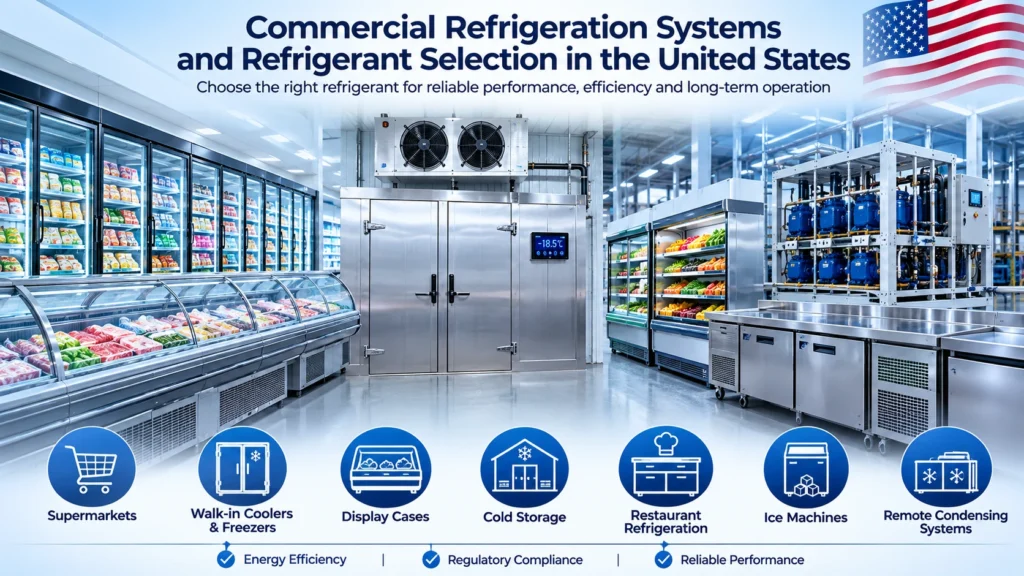
Commercial refrigeration covers many different types of equipment.
Examples include:
- Supermarket refrigeration systems
- Walk-in coolers
- Walk-in freezers
- Reach-in refrigerators and freezers
- Cold storage warehouses
- Food processing refrigeration
- Restaurant refrigeration
- Display cases
- Ice machines
- Remote condensing systems
The appropriate refrigerant can vary significantly between these applications.
A supermarket rack system, for example, may have very different requirements from a small restaurant reach-in refrigerator.
3. Commercial Refrigeration Operating Temperature and Refrigerant Selection
Temperature requirements are another important factor.
Commercial refrigeration applications are often divided broadly into medium-temperature and low-temperature applications.
Medium-Temperature Commercial Refrigeration
Typical applications can include:
- Refrigerated display cases
- Beverage coolers
- Produce storage
- Dairy cases
- Some walk-in coolers
Low-Temperature Commercial Refrigeration
Typical applications can include:
- Commercial freezers
- Frozen-food storage
- Low-temperature display cases
- Some cold storage applications
A refrigerant that performs well in one operating range may not necessarily be the best choice for another.
Buyers should evaluate the refrigerant together with compressor specifications, evaporating and condensing conditions, system capacity, efficiency requirements, and equipment design.
4. Common Commercial Refrigeration Refrigerant Options
The U.S. commercial refrigeration market includes legacy refrigerants, HFC blends, lower-GWP alternatives, hydrocarbons, carbon dioxide, and other refrigerant technologies.
The refrigerants encountered will depend heavily on the age and design of the equipment.
R404A for Commercial Refrigeration
R404A has historically been widely used in commercial refrigeration, particularly in medium- and low-temperature applications.
However, because it has a relatively high global warming potential (GWP), buyers should carefully evaluate the regulatory status and long-term suitability of R404A for the specific application before selecting it for new equipment.
R407-Series Refrigerants for Commercial Refrigeration
The R407 family includes several refrigerant blends designed for different applications.
Because R407 refrigerants are not all interchangeable, buyers should verify the exact designation—such as R407A, R407C, or R407F—rather than ordering simply by the term “R407.”
For a more detailed comparison, read our R404A vs R407C Buyer’s Guide.
R448A and R449A for Commercial Refrigeration
R448A and R449A are lower-GWP blends that may be encountered in commercial refrigeration applications, including some systems where alternatives to higher-GWP refrigerants are being evaluated.
Their suitability depends on the equipment, system design, operating conditions, and applicable regulations.
R290 for Commercial Refrigeration
R290 is propane used as a refrigerant.
It has a very low GWP and is used in certain commercial refrigeration equipment, particularly systems designed specifically for its use.
However, R290 is flammable, so equipment design, charge limits, installation requirements, servicing procedures, technician training, and applicable codes and standards are critical.
It should not be treated as a general-purpose replacement for nonflammable refrigerants.
R744 for Commercial Refrigeration
R744 is carbon dioxide (CO₂).
CO₂ refrigeration systems are increasingly relevant in applications such as supermarket and commercial refrigeration.
R744 has very different operating characteristics from many conventional fluorocarbon refrigerants, including substantially higher system pressures, and therefore requires equipment specifically engineered for CO₂ operation.
5. Check U.S. Refrigerant Regulations Before Purchasing
This is especially important for buyers operating in the United States.
The regulatory environment for refrigerants is changing as the United States phases down HFC production and consumption and implements restrictions for certain technologies and applications under the American Innovation and Manufacturing Act.
EPA’s Technology Transitions requirements establish GWP limits and compliance dates that vary according to sector, subsector, equipment type, system configuration, refrigerant charge, and other factors.
For example, EPA currently lists specific phased requirements for areas including cold storage warehouses and retail-food supermarket systems. Buyers planning new equipment should therefore check the current requirements for their exact application rather than assuming that a refrigerant acceptable in an existing system is automatically suitable for a new installation.
For current requirements, review the EPA Technology Transitions HFC Restrictions by Sector.
Existing Equipment and New Equipment Are Not the Same Question
This distinction is extremely important.
A refrigerant being restricted for certain new systems or installations does not necessarily mean every existing system using that refrigerant must immediately stop operating.
When evaluating refrigerant options, buyers should distinguish between:
New equipment
and
Service of existing equipment
The applicable rules and practical purchasing considerations may be different.
6. Understand EPA Section 608 Requirements
EPA Section 608 regulates refrigerant management for stationary refrigeration and air-conditioning equipment in the United States.
EPA currently states that refrigerants covered by the sales restriction and intended for stationary refrigeration and air-conditioning equipment may generally be purchased only by Section 608-certified technicians or qualifying purchasers such as authorized representatives of employers of certified technicians, subject to the applicable requirements.
For additional information, buyers can review the EPA Refrigerant Sales Restriction.
This is particularly important for online and wholesale refrigerant transactions. EPA states that sellers have responsibilities to verify that purchasers meet applicable requirements.
7. Commercial Refrigeration Refrigerant GWP and Long-Term Availability
Refrigerant selection should not focus only on today’s purchase price.
The AIM Act requires the United States to phase down HFC production and consumption in stages, ultimately reaching 15% of baseline levels by 2036.
This makes long-term planning increasingly important.
Commercial refrigeration buyers evaluating a new system should consider:
- Refrigerant GWP
- Current EPA restrictions
- Future compliance dates
- Equipment availability
- Refrigerant supply
- Technician familiarity
- Service infrastructure
- Retrofit possibilities
- Long-term operating costs
For an existing system, however, replacing an otherwise serviceable system solely because a newer refrigerant exists may not always be the most practical decision.
The entire system lifecycle should be considered.
8. How to Verify Commercial Refrigeration Refrigerant Quality
Choosing the correct refrigerant type is only part of the purchasing process.
Buyers should also verify the quality of the refrigerant being supplied.
AHRI Standard 700 establishes refrigerant purity specifications, composition requirements, contaminant limits, and associated testing methods for refrigerants within its scope, including new, reclaimed, and repackaged refrigerant.
Potential quality considerations include:
- Refrigerant composition
- Moisture
- Acidity
- Non-condensable gases
- High-boiling residue
- Particulates and solids
- Other applicable contaminants
For additional information, see our AHRI Standard 700 Guide for Refrigerant Buyers.
You can also review the official AHRI Standard 700 refrigerant specifications.
9. Review the SDS and COA
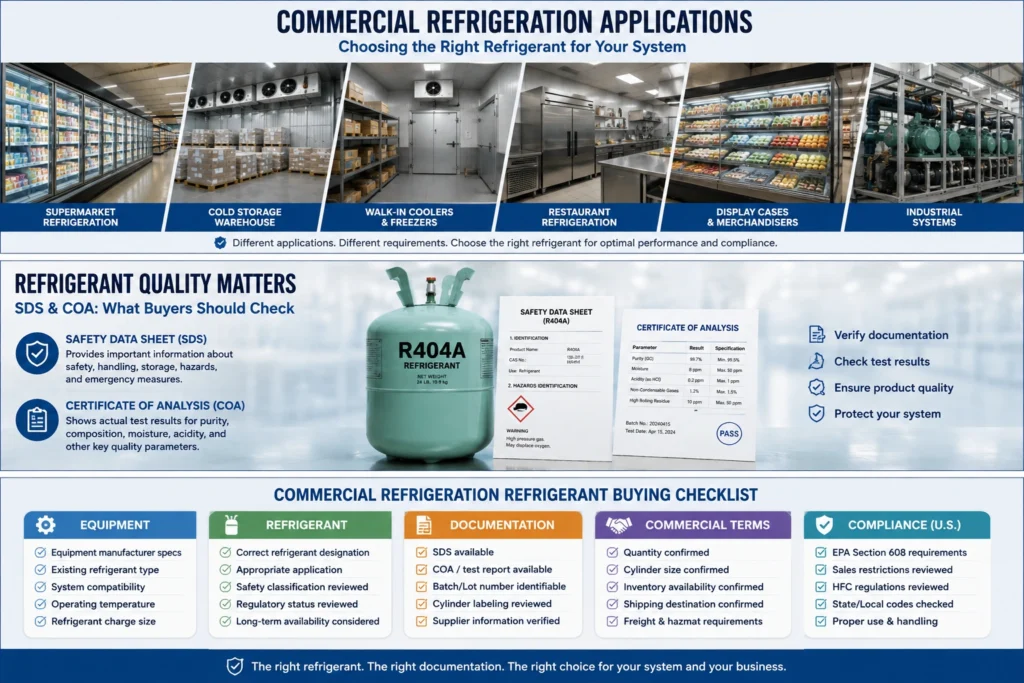
Professional refrigerant buyers should understand the difference between an SDS and a COA.
Refrigerant SDS — Safety Data Sheet
An SDS primarily provides safety and hazard information, including areas such as:
- Product identification
- Hazard information
- Handling and storage
- Exposure considerations
- Emergency response information
- Transportation-related information
Refrigerant COA — Certificate of Analysis
A COA or appropriate batch-quality documentation may provide information related to:
- Refrigerant identity
- Composition or purity
- Moisture
- Acidity
- Non-condensable gases
- Batch or lot information
- Other tested quality characteristics
An SDS should not automatically be treated as proof of refrigerant purity.
For a detailed explanation, read Why SDS and COA Matter When Buying Refrigerant Cylinders.
10. New, Reclaimed, or Repackaged Refrigerant?
Buyers should identify what type of refrigerant they are purchasing.
Ask the supplier whether the refrigerant is:
New refrigerant
Reclaimed refrigerant
or
Repackaged refrigerant
These terms should not be used interchangeably.
Documentation should correspond to the actual product being offered.
AHRI Standard 700 itself covers refrigerants within its scope regardless of whether they are new, reclaimed, or repackaged.
For used refrigerant changing ownership, EPA has additional reclamation requirements. EPA states that used refrigerant generally cannot be sold for use in another appliance unless it has been reclaimed by an EPA-certified reclaimer.
11. Evaluate Total Cost, Not Just Cylinder Price
The cheapest refrigerant cylinder is not necessarily the lowest-cost option for a commercial refrigeration business.
Buyers should consider:
Refrigerant price
- Shipping
- System compatibility
- Installation or retrofit costs
- Energy performance
- Maintenance requirements
- Future refrigerant availability
- Regulatory considerations
A lower initial cylinder price can become expensive if the refrigerant is unsuitable for the equipment or creates additional service requirements.
12. Commercial Refrigeration Refrigerant Buying Questions
Before placing a commercial refrigerant order, consider asking:
- What is the exact refrigerant designation?
- Is the refrigerant suitable for my equipment?
- Is the product new, reclaimed, or repackaged?
- What cylinder sizes are available?
- Is an SDS available?
- Is a COA or batch-quality report available?
- Is the batch or lot number identifiable?
- What purity or composition specifications apply?
- What quantities are currently available?
- What are the shipping terms?
- Are there hazardous-material shipping requirements?
- What documentation is supplied with the order?
- Are applicable U.S. refrigerant sales requirements followed?
A professional supplier should be able to provide clear product information rather than relying only on statements such as “high purity” or “premium quality.”
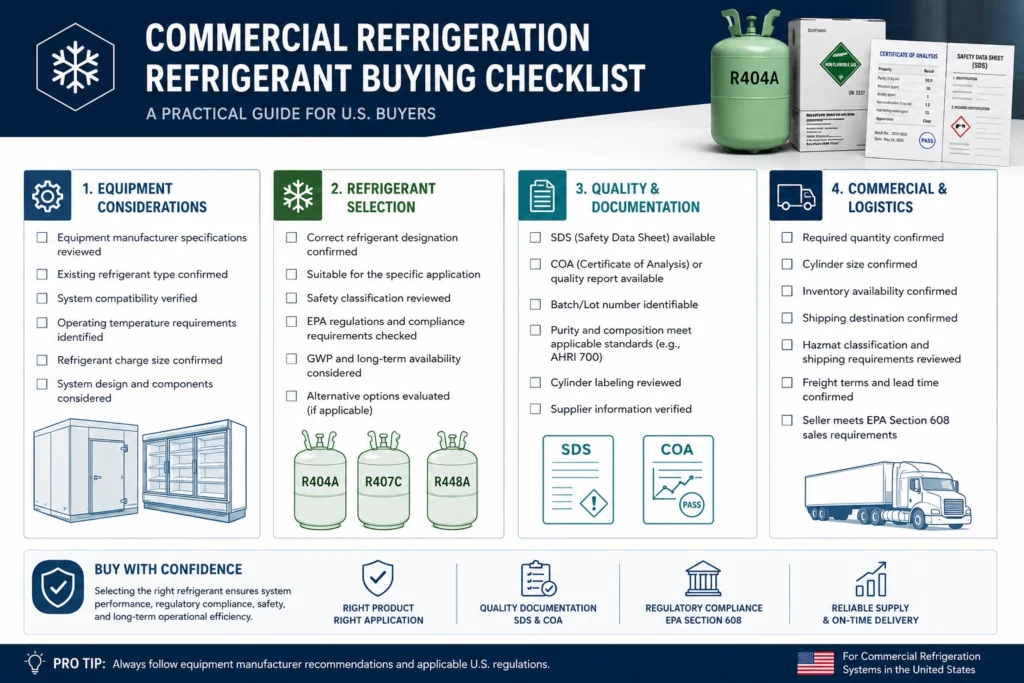
13. Commercial Refrigeration Refrigerant Buying Checklist
Before purchasing, confirm four areas:
Equipment
☐ Equipment manufacturer specifications
☐ Existing refrigerant type
☐ System compatibility
☐ Operating temperature
☐ Refrigerant charge size
Refrigerant
☐ Correct refrigerant designation
☐ Appropriate application
☐ Safety classification reviewed
☐ Regulatory status reviewed
☐ Long-term availability considered
Documentation
☐ SDS available
☐ COA or applicable quality documentation available
☐ Batch/lot information identifiable
☐ Cylinder labeling reviewed
☐ Supplier information verified
Commercial Terms
☐ Quantity confirmed
☐ Cylinder size confirmed
☐ Inventory availability confirmed
☐ Shipping destination confirmed
☐ Freight and hazmat requirements confirmed
Frequently Asked Questions
What is the best refrigerant for commercial refrigeration?
There is no single refrigerant that is best for every commercial refrigeration system. The appropriate choice depends on equipment design, operating temperature, refrigerant charge, safety requirements, regulatory requirements, system efficiency, and service considerations.
Can I replace R404A with another refrigerant?
Not automatically. Alternative refrigerants may require equipment evaluation, component changes, lubricant considerations, control adjustments, relabeling, or other procedures. Buyers should follow equipment manufacturer guidance and qualified HVAC/R technical advice.
Is R290 used in commercial refrigeration?
Yes. R290 is used in certain commercial refrigeration equipment designed for it. Because R290 is flammable, appropriate equipment design, safety requirements, servicing procedures, and applicable codes and standards are essential.
What does AHRI Standard 700 mean when buying refrigerant?
AHRI Standard 700 establishes purity specifications and associated test methods for refrigerants within its scope. Buyers can use appropriate batch documentation, such as a COA or test report, to evaluate product quality information.
Do I need EPA certification to purchase refrigerant in the United States?
For refrigerants subject to EPA’s sales restriction and intended for stationary refrigeration and air-conditioning equipment, EPA generally restricts sales to Section 608-certified technicians and other qualifying purchasers under specified circumstances. Buyers and sellers should review the current EPA requirements for their situation.
Should I choose refrigerant based on GWP alone?
No. GWP is important, particularly as U.S. HFC regulations evolve, but refrigerant selection should also consider equipment compatibility, safety, performance, application, regulatory requirements, availability, serviceability, and lifecycle cost.
Final Thoughts
Choosing the right refrigerant for a commercial refrigeration system in the United States requires a combination of technical, regulatory, quality, and commercial evaluation.
A useful purchasing approach is:
Equipment Compatibility + Application Requirements + U.S. Regulations + Refrigerant Quality + Supplier Documentation + Long-Term Availability
For existing systems, start with the equipment manufacturer’s refrigerant specification and qualified technical guidance. For new systems, buyers should also consider current and future EPA Technology Transitions requirements before committing to a refrigerant technology.
The goal is not simply to purchase a cylinder of refrigerant—it is to select a refrigerant solution appropriate for the equipment, application, regulatory environment, and long-term operating needs.
Request a Refrigerant Quote
Looking for refrigerant cylinders for commercial refrigeration, wholesale distribution, HVAC/R service, or other professional applications?
Contact our team to discuss refrigerant type, cylinder size, current availability, documentation, wholesale quantities, and shipping options.