

R404A vs R407C: Complete Buyer’s Guide to Refrigerant Differences, Applications & Purchasing
R404A vs R407C is an important comparison for HVAC/R buyers evaluating refrigerant applications, system compatibility, operating characteristics, and purchasing requirements. Although both are HFC refrigerant blends, they have different compositions, temperature-glide characteristics, application profiles, and system requirements.
For HVAC/R contractors, wholesalers, distributors, commercial refrigeration companies, and other professional buyers, understanding these differences is important before purchasing refrigerant cylinders or considering a system retrofit.
This guide explains the key differences between R404A and R407C and what professional buyers should check before ordering.
1. What Is R404A Refrigerant?
R404A is a zeotropic HFC refrigerant blend that has historically been widely used in commercial refrigeration and low- and medium-temperature refrigeration applications.
Common applications have included:
- Supermarket refrigeration
- Walk-in freezers
- Commercial freezers
- Cold storage systems
- Refrigerated transport
- Food-service refrigeration
- Ice-making equipment
- Other refrigeration equipment designed for R404A
R404A has zero ozone depletion potential, but its relatively high global warming potential has resulted in increasing regulatory attention and restrictions for certain new equipment and applications in the United States.
EPA requirements vary according to the refrigeration sector, equipment type, application, and date, so buyers should verify the rules applicable to their specific equipment rather than assuming R404A is universally permitted or prohibited.
2. What Is R407C Refrigerant?
R407C is also a zeotropic HFC refrigerant blend, but its composition and operating characteristics differ substantially from R404A.
R407C has commonly been associated with:
- Air-conditioning systems
- Heat pumps
- Residential and light commercial HVAC
- Certain industrial air-conditioning applications
- Equipment specifically designed or approved for R407C
EPA lists R407C in several refrigeration and air-conditioning end-use categories, but suitability still depends on the specific equipment and application.
This is one of the most important points for buyers:
R404A and R407C should not be treated as interchangeable refrigerants simply because both are HFC blends.
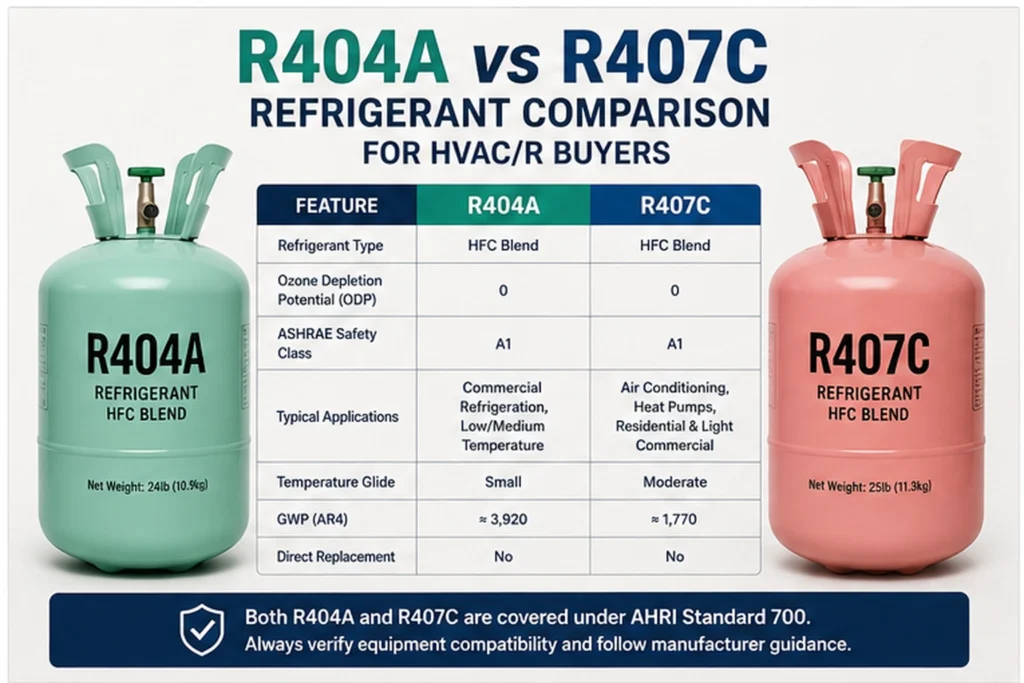
3. R404A vs R407C: Key Differences
| Feature | R404A | R407C |
|---|---|---|
| Refrigerant Type | HFC blend | HFC blend |
| Ozone Depletion Potential | 0 | 0 |
| ASHRAE Safety Class | A1 | A1 |
| Typical Application Profile | Commercial refrigeration | Air conditioning / heat pumps |
| Temperature Glide | Relatively small | More significant |
| GWP | Higher | Lower than R404A |
| Directly Interchangeable? | No | No |
| AHRI 700 Covered | Yes | Yes |
EPA reference values list R404A at a GWP of approximately 3,920 and R407C at approximately 1,770.
GWP, however, should not be the only factor used to choose a refrigerant.
Equipment compatibility, system design, operating temperature, compressor requirements, lubricant, expansion devices, manufacturer guidance, and applicable regulations also matter.
4. R404A Applications
R404A became widely associated with commercial refrigeration because of its operating characteristics in low- and medium-temperature applications.
Typical historical applications include:
Commercial Freezers
R404A has been commonly used in commercial freezer systems designed specifically for this refrigerant.
Supermarket Refrigeration
Many legacy supermarket refrigeration systems have operated with R404A.
Cold Storage
Low-temperature cold-storage applications have also historically used R404A.
Refrigerated Transport
R404A has been used in refrigerated transport applications, and EPA currently lists it as acceptable for this particular end-use.
The important distinction is that the regulatory treatment of R404A can vary by application.
5. R407C Applications
R407C has a different application profile.
It is commonly associated with:
- Residential air conditioning
- Light commercial air conditioning
- Heat pumps
- Packaged HVAC equipment
- Certain industrial air-conditioning systems
Because R407C has noticeable temperature glide, system design and charging practices require particular attention.
It should not automatically be selected merely because a buyer is looking for a lower-GWP alternative to another refrigerant.
6. Can R407C Replace R404A?
R407C should not be considered a universal direct replacement for R404A.
This is one of the most important purchasing points in an R404A vs R407C comparison.
Changing refrigerants can affect:
- Operating pressure
- Discharge temperature
- Refrigeration capacity
- System efficiency
- Compressor operation
- Expansion-device performance
- Lubricant compatibility
- Charging procedures
- System controls
Before considering a refrigerant conversion, buyers and technicians should review:
- Equipment manufacturer guidance
- Compressor manufacturer requirements
- Retrofit procedures
- Lubricant requirements
- Expansion-device compatibility
- Operating-temperature requirements
- Applicable U.S. regulations
A refrigerant should be selected according to the specific equipment and application, not simply according to cylinder price or availability.
7. Understanding Temperature Glide
Temperature glide is especially important when discussing R407C.
Because R407C is a zeotropic blend, its components do not evaporate and condense at exactly the same temperature.
This means technicians may need to distinguish between:
- Bubble point
- Dew point
depending on the measurement and service procedure.
R404A is also a blend, but its temperature glide is generally much smaller.
For buyers, the important point is simple:
R407C requires technicians to understand the operating characteristics of the blend and follow appropriate charging and servicing procedures.
8. R404A vs R407C Operating Characteristics
Two refrigerants should never be considered interchangeable based only on similar cylinder size or availability.
Before purchasing either R404A or R407C, buyers should verify:
Equipment Compatibility
Confirm the refrigerant specified by the equipment or system manufacturer.
Operating Temperature
Determine whether the application is air conditioning, medium-temperature refrigeration, low-temperature refrigeration, or another specialized application.
Compressor Requirements
Verify that the compressor is suitable for the selected refrigerant.
Lubricant
Confirm the required lubricant and manufacturer recommendations.
Charging Procedure
Because both refrigerants are blends, proper liquid charging procedures and manufacturer guidance should be followed.
9. R404A vs R407C and U.S. Refrigerant Regulations
U.S. refrigerant regulations continue to evolve as higher-GWP HFCs are phased down and technology-transition requirements take effect.
However, buyers should avoid oversimplified statements such as:
“R404A is completely banned.”
The regulatory answer depends on factors such as:
- Equipment type
- Refrigeration sector
- Whether equipment is new or existing
- Installation or manufacture date
- Refrigerant GWP
- Specific end-use
EPA’s SNAP program maintains refrigerant listings by individual refrigeration and air-conditioning end-use, while additional HFC requirements are implemented under the AIM Act.
For professional buyers, the safest approach is to confirm the current requirements for the exact application before purchasing refrigerant for a new installation or retrofit.
For current U.S. refrigerant requirements and acceptable substitutes by application, buyers should review the EPA SNAP refrigerant listings.
10. EPA Section 608 Purchasing Requirements
Buyers should also understand that refrigerant sales in the United States are subject to EPA requirements.
For refrigerants intended for stationary refrigeration and air-conditioning equipment, EPA generally restricts purchases to Section 608-certified technicians and qualifying employers or authorized representatives that meet the applicable requirements.
This means professional suppliers should have procedures for verifying eligible purchasers.
Buyers can review the current purchasing requirements on the EPA Refrigerant Sales Restriction page.
11. Refrigerant Purity Matters
Price should never be the only factor when comparing R404A vs R407C suppliers.
Poor-quality or contaminated refrigerant can create serious operational problems.
Potential contaminants include:
- Excess moisture
- Acidity
- Non-condensable gases
- High-boiling residue
- Particulates
- Incorrect refrigerant composition
- Cross-contamination with other refrigerants
For this reason, buyers should review product quality documentation before placing larger orders.
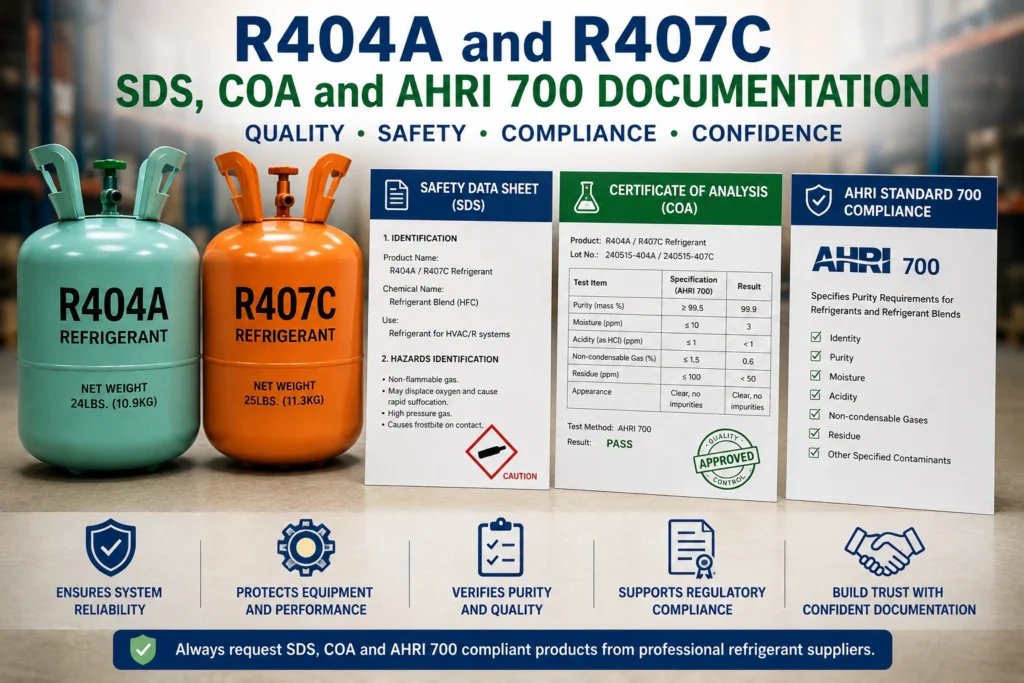
12. R404A, R407C and AHRI Standard 700
AHRI Standard 700 is an important industry reference for refrigerant purity, composition, contaminants, and associated testing methods.
Both R404A and R407C are specifically included within the scope of AHRI Standard 700.
Buyers can review the current refrigerant specifications and standard information on the AHRI Standard 700 official page.
AHRI 700 applies to refrigerants within its scope regardless of whether the refrigerant source is new, reclaimed, repackaged, or a combination covered by the standard.
For a more detailed explanation of refrigerant purity requirements, read our AHRI Standard 700 Guide for Refrigerant Buyers.
13. Check the Certificate of Analysis
A Certificate of Analysis (COA) can provide batch-specific information about refrigerant quality.
Depending on the supplier and testing documentation, a COA may include information such as:
- Refrigerant identification
- Batch or lot number
- Composition
- Purity
- Moisture
- Acidity
- Non-condensable gases
- Residue
- Test results
Buyers placing wholesale or recurring orders should ask whether batch-specific documentation is available.
14. Review the Safety Data Sheet
The Safety Data Sheet (SDS) provides important safety and handling information.
An SDS typically covers:
- Product identification
- Hazard information
- Composition
- First-aid measures
- Fire-fighting measures
- Accidental release procedures
- Handling and storage
- Exposure controls
- Physical and chemical properties
- Transport information
However, an SDS and COA serve different purposes.
An SDS is primarily a safety document; it should not be treated as batch-specific proof of refrigerant purity.
For a detailed explanation, read our Refrigerant SDS and COA Buying Guide.
15. Check Refrigerant Cylinders Before Purchasing
Cylinder condition is another important part of supplier evaluation.
Before accepting R404A or R407C cylinders, buyers should review:
- Refrigerant identification
- Cylinder condition
- Valve condition
- Net weight
- Packaging
- Safety labels
- Lot or batch information
- Shipping condition
- Applicable cylinder requirements
Damaged, leaking, incorrectly labeled, or poorly packaged cylinders should be investigated before use.
16. R404A vs R407C Cylinder Size and Order Quantity
Before requesting a quotation, buyers should clearly specify:
- Refrigerant type
- Required cylinder size
- Number of cylinders
- Delivery location
- Required documentation
- Purchasing frequency
- Target delivery date
For wholesale orders, also ask about:
- Pallet quantity
- Minimum order quantity
- Lead time
- Available inventory
- Freight terms
- Shipping options
Clear purchasing specifications make supplier quotations easier to compare.
17. How to Compare R404A and R407C Suppliers
A reliable refrigerant supplier should be evaluated on more than price.
Product
Confirm:
- Exact refrigerant designation
- Cylinder size
- Net refrigerant weight
- Current availability
Quality
Ask about:
- Product source
- Purity
- Batch testing
- Quality-control procedures
- AHRI 700 specifications where applicable
Documentation
Request:
- SDS
- COA when available
- Product specifications
- Relevant shipping documentation
Commercial Terms
Compare:
- Unit price
- MOQ
- Lead time
- Freight cost
- Payment terms
- Inventory availability
- Delivery terms
18. Evaluate Total Buying Cost
The lowest cylinder price does not always mean the lowest total purchasing cost.
Buyers should consider:
Total Buying Cost = Product Price + Freight + Handling + Documentation + Delivery Risk + Quality Risk
A slightly lower purchase price can become expensive if the order involves:
- Product contamination
- Incorrect refrigerant
- Cylinder damage
- Missing documentation
- Shipping delays
- Unreliable inventory
- Difficult supplier communication
For professional buyers, consistency and documentation can be just as important as unit price.
19. Commercial Refrigeration Buyers
For supermarkets, cold storage facilities, restaurants, food-service businesses, warehouses, and other commercial refrigeration applications, refrigerant selection should begin with equipment compatibility and application requirements.
Buyers should also consider:
- Operating temperature
- System design
- Refrigerant GWP
- Regulatory requirements
- Long-term availability
- Service requirements
For a broader discussion, read our Commercial Refrigeration Refrigerant Buyer’s Guide.
20. R404A vs R407C Buying Questions
Before placing an order, buyers should ask:
- Is the equipment designed or approved for R404A or R407C?
- What refrigerant is currently in the system?
- What is the intended application?
- What operating temperature is required?
- What cylinder size is available?
- What is the net refrigerant weight?
- Is an SDS available?
- Is a COA available?
- Is batch or lot information available?
- What quality specifications are used?
- What is the product source?
- What is the minimum order quantity?
- What inventory is currently available?
- What is the lead time?
- What shipping options are available?
- Are there regulatory requirements affecting the intended application?
21. R404A vs R407C Buyer’s Checklist
Before purchasing, confirm:
Equipment
- Correct refrigerant designation
- Equipment compatibility
- Compressor requirements
- Lubricant requirements
- Operating temperature
- Manufacturer guidance
Refrigerant
- R404A or R407C
- Product source
- Purity
- Correct cylinder size
- Correct net weight
Documentation
- SDS
- COA
- Batch or lot information
- Product specifications
Supplier
- Current inventory
- MOQ
- Unit price
- Lead time
- Freight terms
- Supplier reliability
Regulatory
- EPA Section 608 purchasing requirements
- Application-specific EPA requirements
- Applicable state or local requirements

Frequently Asked Questions About R404A vs R407C
Is R407C the same as R404A?
No. R404A and R407C have different refrigerant compositions, operating characteristics, temperature glide, and typical applications.
Can R407C directly replace R404A?
Not automatically. Refrigerant conversions should be evaluated according to equipment design, compressor requirements, lubricant, controls, expansion devices, operating conditions, manufacturer guidance, and applicable regulations.
Which refrigerant has the lower GWP?
EPA reference values list R407C at a substantially lower GWP than R404A. However, GWP alone does not determine whether a refrigerant is suitable for a particular system.
Is R404A still used in the United States?
Yes, R404A remains relevant in existing equipment and certain applications, but regulatory restrictions differ by end-use and can apply to new equipment. Buyers should verify the current EPA requirements for their specific application.
Are R404A and R407C covered by AHRI Standard 700?
Yes. Both refrigerants are specifically listed within the scope of AHRI Standard 700.
Do I need EPA certification to purchase R404A or R407C?
For refrigerant intended for stationary refrigeration and air-conditioning equipment, EPA sales restrictions generally require the purchaser to be a Section 608-certified technician or fall within another qualifying purchaser category.
Should I request both an SDS and COA?
For professional purchasing, both can be useful because they serve different purposes. The SDS primarily addresses safety and handling, while a COA can provide batch-specific quality information when supplied.
Final Thoughts
The choice between R404A vs R407C should not be based on price alone.
These refrigerants have different compositions, operating characteristics, temperature-glide behavior, application profiles, and system requirements.
For professional HVAC/R buyers, a better purchasing approach is:
Equipment Compatibility + Application Requirements + Refrigerant Quality + Documentation + U.S. Regulations + Supplier Reliability
Before ordering, confirm the refrigerant specified for the equipment, review available SDS and COA documentation, evaluate product quality, understand applicable regulations, and compare the supplier’s inventory, lead time, and commercial terms.
Request an R404A or R407C Refrigerant Quote
Looking for R404A or R407C refrigerant for HVAC/R service, commercial refrigeration, wholesale distribution, or other professional applications?
Contact our team to discuss:
- R404A or R407C
- Cylinder size
- Current availability
- Quantity requirements
- SDS and COA documentation
- Wholesale orders
- Shipping options