
Why SDS and COA Matter When Buying Refrigerant Cylinders
When purchasing refrigerant cylinders, price and availability are not the only factors HVAC/R buyers should consider. Refrigerant SDS and COA documents provide important information about product safety, handling requirements, specifications, and quality.
For HVAC contractors, wholesalers, distributors, and commercial refrigeration companies, reviewing refrigerant SDS and COA documentation before placing an order can help identify potential safety, quality, and documentation issues.
Understanding the difference between these documents is particularly important when purchasing refrigerant in wholesale quantities. This guide explains what an SDS and COA are, how they differ, and what buyers should check before purchasing refrigerant cylinders.
What Is an SDS for Refrigerant?
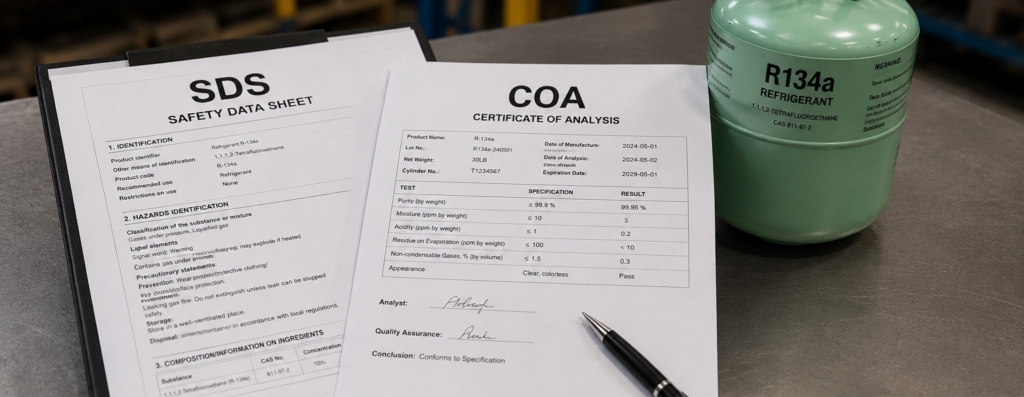
An SDS (Safety Data Sheet) is a standardized document that communicates safety and hazard information about a chemical product.
For refrigerants, an SDS typically provides information concerning:
- Product identification
- Hazard identification
- Chemical composition
- First-aid measures
- Fire-fighting measures
- Accidental release measures
- Handling and storage
- Exposure controls and personal protection
- Physical and chemical properties
- Stability and reactivity
- Toxicological information
- Disposal considerations
- Transportation information
For HVAC/R companies, an SDS helps technicians, warehouse personnel, and other professionals understand how a refrigerant should be handled and stored safely.
What Is a COA for Refrigerant?
A Certificate of Analysis (COA) serves a different purpose.
While an SDS focuses primarily on safety and hazard communication, a COA provides information about the tested characteristics of a refrigerant product or batch.
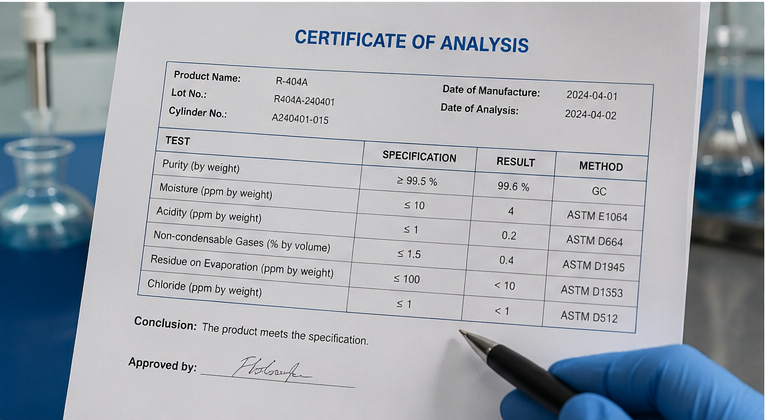
Depending on the refrigerant and supplier, a COA may contain:
- Refrigerant designation
- Batch or lot number
- Refrigerant purity or composition
- Moisture content
- Acidity
- Non-condensable gases
- High-boiling residue
- Chloride
- Test results
- Test date
- Applicable specifications
For wholesale refrigerant buyers, this information can help evaluate whether the product corresponds to the supplier’s stated specifications.
SDS vs. COA: What Is the Difference?
Refrigerant SDS and COA documents should not be treated as interchangeable.
| Document | Primary Purpose | What Buyers Learn |
|---|---|---|
| SDS | Safety and hazard communication | Handling, storage, hazards and emergency information |
| COA | Product/batch analysis | Purity, composition and other tested characteristics |
A simple way to remember the difference is:
SDS = Safety information
COA = Quality and analysis information
Professional refrigerant buyers may need both documents because they answer different questions about the product.
Why Refrigerant SDS and COA Documents Matter
For commercial buyers, documentation becomes increasingly important as purchasing volume increases.
An SDS can help companies understand potential hazards and appropriate handling procedures. A COA can provide information about tested product characteristics.
Together, refrigerant SDS and COA documentation can help buyers evaluate:
- Product identification
- Safety information
- Handling and storage requirements
- Refrigerant specifications
- Quality claims
- Batch information
- Supplier documentation
However, documentation should be considered alongside other purchasing factors such as supplier reliability, cylinder condition, product origin, logistics, and applicable regulations.
What Does a Refrigerant COA Tell You About Purity?
One common reason buyers request a COA is to evaluate refrigerant purity and other quality characteristics.
A supplier may advertise a product as “99.9% pure,” but professional buyers should look beyond a single purity percentage.
Depending on the refrigerant, relevant COA parameters may include:
- Purity or composition
- Moisture
- Acidity
- Non-condensable gases
- High-boiling residue
- Other specified contaminants
These measurements provide more useful information about the tested product or batch than a marketing purity claim alone.
What Is AHRI Standard 700?
HVAC/R buyers may encounter references to AHRI Standard 700 when reviewing refrigerant quality documentation.
AHRI Standard 700 establishes specifications for refrigerant purity and addresses characteristics and contaminants relevant to refrigerant quality.
Professional buyers should review current information directly from the Air-Conditioning, Heating, and Refrigeration Institute (AHRI).
When a supplier states that its refrigerant meets a particular specification, buyers should consider requesting appropriate supporting documentation.
Is an SDS Enough to Verify Refrigerant Quality?
No. An SDS should not generally be used as a substitute for product-quality documentation.
The SDS primarily addresses safety and hazard communication.
If a buyer wants information concerning refrigerant purity, composition, moisture, acidity, non-condensable gases, or other quality characteristics, an appropriate COA or test report may provide more relevant information.
This distinction is one of the main reasons professional buyers should understand both refrigerant SDS and COA documentation.
What Should Buyers Check on a Refrigerant COA?
Before accepting a COA as supporting documentation, consider checking the following:
Product Identification
Does the refrigerant designation on the COA match the product being purchased?
For example, documentation for R22 should not be assumed to apply to R410A or R404A.
Batch or Lot Number
Does the document contain a batch or lot number that can be associated with the inventory being offered?
Test Results
Does the COA provide actual analytical results rather than only general marketing claims?
Specifications
Does the document identify the specification or acceptance criteria being referenced?
Testing Date
When was the refrigerant tested?
Traceability
Can the supplier connect the COA with the actual inventory being sold?
These questions become particularly important when purchasing pallet or wholesale quantities.
Check Documentation Against the Refrigerant Cylinder
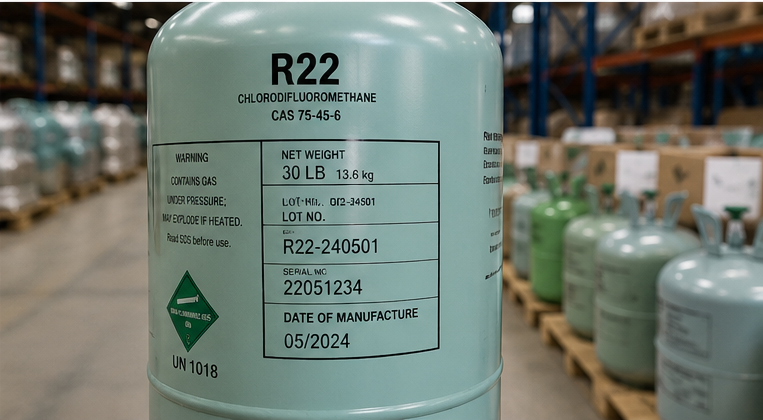
Documentation should also be compared with the physical refrigerant cylinders.
Buyers should check details such as:
- Refrigerant designation
- Cylinder label
- Net weight
- Batch or lot information
- Manufacturer or supplier information
- Valve and cylinder condition
- Applicable cylinder markings
- SDS and COA information
If information on the cylinder conflicts with the documentation, buyers should ask the supplier for clarification before completing a large order.
SDS and COA for R22 Refrigerant
Documentation can be especially important when evaluating R22 because buyers may encounter products from different sources.
Before purchasing R22, HVAC/R buyers should consider product origin, cylinder specifications, quality documentation, supplier information, and applicable regulatory requirements.
For additional purchasing information, read our R22 Refrigerant Buying Guide for HVAC/R Buyers.
View our R22 Refrigerant product information for available specifications and commercial inquiries.
What About Refrigerant Blends?
Documentation is also important when purchasing refrigerant blends such as:
- R404A
- R407C
- R410A
- R448A
- R449A
- R454B
Because these products contain multiple refrigerant components, composition is an important quality consideration.
If you are comparing refrigerant options, you can also read our R404A vs R407C: What Buyers Should Confirm Before Ordering guide.
Do You Need an SDS When Shipping Refrigerant?
An SDS can provide useful hazard and transportation information, but it should not be assumed to be the only documentation required for transportation.
Requirements can depend on:
- Refrigerant type
- Cylinder configuration
- Quantity
- Transportation mode
- Origin and destination
- Applicable dangerous-goods regulations
For international shipments, buyers and sellers should verify the applicable classification, packaging, marking, labeling, documentation, and carrier requirements.
U.S. businesses can review refrigerant management information through the U.S. Environmental Protection Agency Section 608 resources.
Red Flags When Reviewing Refrigerant Documentation
Professional buyers should investigate further when:
- SDS information does not match the refrigerant
- COA identifies a different product
- Important product information is missing
- Batch information cannot be verified
- Cylinder labels conflict with commercial documents
- Net weight information is inconsistent
- Supplier cannot explain product origin
- Quality claims cannot be supported
- Physical inventory cannot be confirmed
One inconsistency does not automatically mean a product is unsuitable, but important discrepancies should be resolved before a significant purchase.
Refrigerant SDS and COA Checklist for Buyers
Before purchasing refrigerant cylinders, consider this checklist:
Product
- Refrigerant designation confirmed
- Cylinder size confirmed
- Net refrigerant weight confirmed
- Labels inspected
- Cylinder and valve condition checked
SDS
- Correct refrigerant identified
- Supplier information reviewed
- Hazards understood
- Handling requirements reviewed
- Storage information reviewed
COA
- Product identification matches
- Batch or lot information reviewed
- Purity/composition checked
- Moisture results reviewed where applicable
- Acidity reviewed where applicable
- Non-condensable gases reviewed where applicable
- Relevant specifications identified
Supplier
- Company information verified
- Product origin understood
- Inventory availability confirmed
- Actual inventory photos available where appropriate
- Commercial terms confirmed
Logistics
- Delivery destination confirmed
- Transportation requirements reviewed
- Freight costs understood
- Total landed cost calculated
Frequently Asked Questions About Refrigerant SDS and COA
Is an SDS the same as a COA?
No. An SDS primarily communicates safety and hazard information, while a COA provides analytical or quality information about a product or batch.
What should a refrigerant COA include?
Depending on the product and supplier, a COA may include refrigerant identification, purity or composition, moisture, acidity, non-condensable gases, residue, batch information, and test results.
Does a COA prove refrigerant quality?
A COA can provide useful analytical information, but buyers should determine whether the document corresponds to the actual product or batch being purchased.
Should wholesale refrigerant buyers request SDS and COA documents?
For commercial purchases, reviewing appropriate safety and quality documentation can help buyers better understand the product and evaluate supplier claims.
What is the difference between a COA and AHRI Standard 700?
AHRI Standard 700 establishes refrigerant purity specifications. A COA can contain analytical results that may be compared with applicable specifications.
Final Thoughts
Refrigerant SDS and COA documentation can provide professional HVAC/R buyers with important information before purchasing refrigerant cylinders.
An SDS focuses primarily on safety, hazards, handling, and storage. A COA focuses on tested product characteristics such as purity or composition and other relevant quality parameters.
For wholesale purchases, buyers should consider documentation together with product traceability, cylinder condition, supplier reliability, applicable requirements, logistics, and total landed cost.
Reviewing these details before placing an order can help businesses make better-informed refrigerant purchasing decisions.
Request a Refrigerant Quote
Looking for refrigerant cylinders for commercial or wholesale HVAC/R applications?
Contact our team with your:
- Refrigerant type
- Required quantity
- Cylinder size
- Delivery destination
- Documentation requirements
- Purchasing schedule
We can discuss current availability, specifications, available documentation, order quantities, and logistics options.