
R22 Refrigerant: Buying Guide for HVAC/R Buyers
R22 refrigerant remains important for HVAC/R contractors, wholesalers, distributors, and facility operators responsible for maintaining existing air-conditioning and refrigeration equipment.
However, buying R22 refrigerant today involves more than comparing cylinder prices. Professional buyers should consider equipment compatibility, refrigerant source, product quality, U.S. purchasing requirements, cylinder condition, supplier documentation, and total delivered cost.
In the United States, production and import of HCFC-22 ended in 2020. However, existing R22 equipment can continue to be serviced, and supplies such as recovered and reclaimed R22 and HCFC-22 produced before 2020 can continue to support existing systems.
This guide explains what HVAC/R buyers should check before placing an R22 refrigerant order.
1. What Is R22 Refrigerant?
R22, also known as HCFC-22, is a hydrochlorofluorocarbon refrigerant that was widely used in air-conditioning and refrigeration systems.
R22 can still be found in many existing applications, including:
- Residential air-conditioning systems
- Light-commercial air conditioning
- Commercial refrigeration
- Older heat pumps
- Condensing units
- Refrigeration systems
- Certain industrial cooling applications
Because HCFC-22 contributes to ozone depletion, its production and import have been phased out in the United States.
However, the phaseout does not require owners to immediately replace existing R22 equipment. EPA confirms that existing HCFC-22 equipment may continue to be serviced.
2. Can You Still Buy R22 Refrigerant in the United States?
R22 refrigerant can still be available for servicing existing equipment, but buyers need to understand the current supply environment.
Since January 1, 2020, new HCFC-22 generally can no longer be produced or imported into the United States for normal servicing needs. Existing systems can instead be supported by qualifying supplies such as reclaimed refrigerant and HCFC-22 produced before the phaseout.
The important distinction is:
The R22 phaseout does not mean an immediate ban on servicing existing R22 equipment.
EPA states that existing HCFC-22 systems can continue to be serviced and does not mandate conversion of all existing systems to alternative refrigerants.
3. U.S. Purchasing Requirements
U.S. buyers should verify purchasing requirements before placing an order.
For refrigerants intended for stationary refrigeration and air-conditioning equipment, EPA’s refrigerant sales restriction generally requires the purchaser to be a Section 608-certified technician or fall within another permitted purchaser category.
Wholesalers also have verification and recordkeeping responsibilities when selling refrigerant.
EPA Refrigerant Sales Restriction
For commercial purchases, buyers should therefore be prepared to provide appropriate certification or other required purchaser information.
4. R22 Refrigerant Quality: What Buyers Should Check
Price should not be the only factor when evaluating R22 refrigerant.
Poor-quality, contaminated, incorrectly identified, or improperly handled refrigerant can create equipment and service problems.
Professional buyers should consider:
- Refrigerant identity and composition
- Moisture
- Acidity
- Non-condensable gases
- High-boiling residue
- Particulates or other contamination
- Batch or lot identification
- Cylinder condition
- Supporting quality documentation
For wholesale quantities and repeat orders, traceability becomes particularly important.
5. R22 Refrigerant and AHRI Standard 700
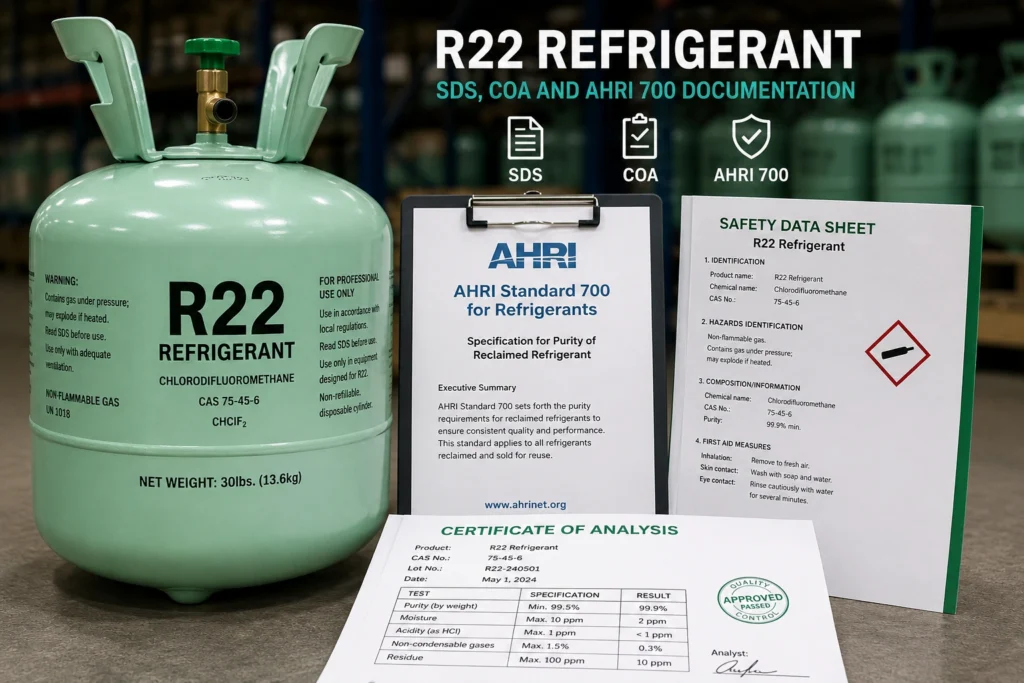
AHRI Standard 700 establishes refrigerant purity specifications, verifies composition, and specifies associated test methods. R22 is specifically included within the standard’s scope.
For buyers, AHRI 700 provides an important framework when reviewing refrigerant quality and supplier documentation.
However, buyers should distinguish between:
“Meets AHRI Standard 700 specifications”
and
“AHRI Certified”
These statements should not automatically be treated as equivalent.
For a more detailed explanation of refrigerant purity requirements, read our AHRI Standard 700 Guide for Refrigerant Buyers.
6. Check the R22 Refrigerant COA
A Certificate of Analysis, or COA, can provide important product- or batch-specific quality information.
Depending on the supplier and testing process, an R22 refrigerant COA may include:
- Product identification
- Composition or purity
- Moisture
- Acidity
- Non-condensable gases
- High-boiling residue
- Batch or lot number
- Test date
- Quality-control information
Buyers should check whether the COA corresponds to the actual product or batch being offered.
A generic specification sheet should not automatically be treated as batch-specific test evidence.
7. Review the R22 Refrigerant SDS
The Safety Data Sheet, or SDS, serves a different purpose from a COA.
An SDS generally provides information concerning:
- Product identification
- Hazards
- Safe handling
- Storage
- Exposure controls
- First-aid measures
- Accidental release procedures
- Transportation
- Regulatory information
An SDS is important documentation, but it should not be treated by itself as proof of the purity of a particular refrigerant batch.
For a detailed explanation of the difference between these documents, read our Refrigerant SDS and COA Buying Guide.
8. Understand the Source of R22 Refrigerant
The source of R22 is especially important in today’s U.S. market.
Buyers may encounter terms such as reclaimed, recovered, recycled, repackaged, or previously produced R22. These terms should not automatically be treated as interchangeable.
Reclaimed R22 Refrigerant
Reclamation involves processing used refrigerant to applicable purity specifications.
EPA notes that recovered refrigerant generally cannot be sold to a new owner for use as refrigerant unless it has been reclaimed by an EPA-certified reclaimer.
When evaluating reclaimed R22, buyers should ask:
- Who reclaimed the refrigerant?
- What quality specifications are represented?
- Is batch testing available?
- Is a COA available?
- Is the product traceable?
Previously Produced R22 Refrigerant
R22 produced before the applicable phaseout may remain available from existing stocks.
EPA specifically recognizes previously produced HCFC-22 as one source that can support existing systems after the phaseout.
Buyers should still verify product source, condition, documentation, and supplier information.
Recovered or Recycled R22 Refrigerant
Recovered, recycled, and reclaimed refrigerant do not necessarily mean the same thing.
For a commercial purchase, understand exactly how the supplier describes the product and what documentation supports that description.
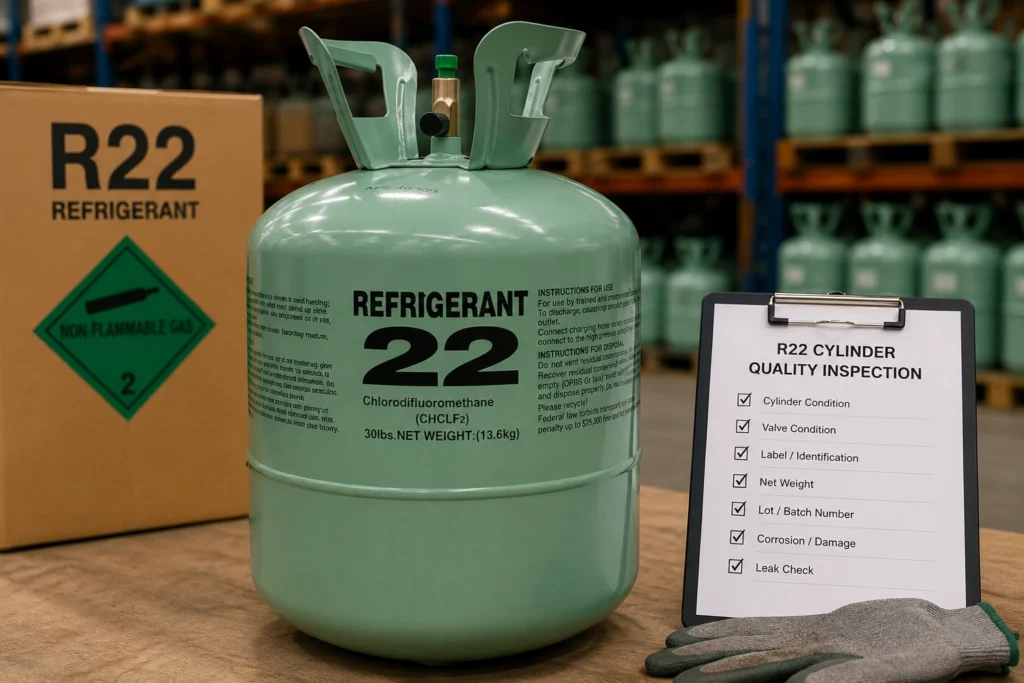
9. How to Inspect the Cylinder Before Buying
The refrigerant itself is only one part of the purchase.
Buyers should also inspect or verify:
- Cylinder condition
- Valve condition
- Product label
- Refrigerant identification
- Net refrigerant weight
- Lot or batch markings
- Packaging condition
- Signs of corrosion
- Signs of physical damage
- Signs of tampering
For remote purchases, consider requesting recent photographs of the actual inventory.
For a large commercial order, relying only on generic catalog photographs may not provide enough information.
10. Cylinder Size and Order Quantity
Before comparing supplier quotations, make sure you are comparing the same product configuration.
Confirm:
- Cylinder size
- Net refrigerant weight
- Number of cylinders
- Units per pallet
- Minimum order quantity
- Current available inventory
- Warehouse location
- Lead time
This is especially important when comparing price per cylinder because two quotations may represent different net weights or commercial terms.
11. How to Compare Suppliers
A professional supplier should be evaluated on more than the advertised cylinder price.
R22 Product
Check:
- Exact refrigerant
- Refrigerant source
- Cylinder size
- Cylinder condition
- Available quantity
R22 Quality
Check:
- Quality specifications
- COA availability
- Batch traceability
- Testing information
R22 Documentation
Check:
- SDS
- COA
- Product specifications
- Relevant shipping documentation
Commercial Terms
Compare:
- Unit price
- Minimum order quantity
- Payment terms
- Lead time
- Warehouse location
- Shipping
- Claims or return procedures
For B2B buyers, supplier reliability can be just as important as initial price.
12. Price and Total Buying Cost
R22 refrigerant pricing can vary based on several factors:
- Product source
- Available inventory
- Cylinder size
- Order quantity
- Product condition
- Documentation
- Warehouse location
- Freight
- Hazardous-material handling requirements
- Market availability
EPA notes that R22 price and availability may change as the market increasingly relies on reclaimed and previously produced supplies.
Instead of comparing only:
Price per cylinder
professional buyers should consider:
Total delivered cost per cylinder
A slightly higher unit price may still represent a better commercial purchase if documentation, inventory, shipping, traceability, and supplier reliability are stronger.
13. Should You Keep an Existing R22 System?
There is no universal answer.
EPA does not require owners to replace existing HCFC-22 systems simply because R22 has been phased out of new production and import. Existing equipment may continue to be serviced.
System owners should consider:
- Equipment age
- System condition
- Leak history
- Repair frequency
- R22 availability
- Refrigerant cost
- Energy efficiency
- Retrofit cost
- Replacement cost
- Long-term maintenance needs
An operating R22 system with manageable maintenance requirements presents a different decision from an aging system experiencing frequent leaks or major component failures.
14. Replacement and Retrofit Considerations
Buyers should be cautious with products marketed as universal “drop-in replacements” for R22.
EPA notes that alternative refrigerants must be appropriate for the particular end use and that some alternatives are not allowed in retrofits.
Before changing refrigerants, evaluate:
- Equipment compatibility
- Compressor requirements
- Lubricant
- Seals and components
- Pressure characteristics
- Capacity
- Efficiency
- Charging procedures
- Manufacturer guidance
- Applicable regulations and codes
The appropriate approach depends on the specific equipment and application.
Buyers evaluating refrigerants for supermarkets, cold storage, restaurants, and other commercial systems can also read our Commercial Refrigeration Refrigerant Buyer’s Guide.
15. R22 Refrigerant Buying Questions
Before placing an R22 order, ask the supplier:
- What exactly is being supplied?
- What is the source of the R22?
- How is the refrigerant represented?
- What cylinder size is available?
- What is the net refrigerant weight?
- Is a COA available?
- Is an SDS available?
- Is batch or lot information available?
- What quality specifications are represented?
- Where is the inventory located?
- What quantity is currently available?
- What is the minimum order quantity?
- What are the payment terms?
- What shipping options are available?
- What purchaser documentation is required?
Clear answers can help buyers compare suppliers and reduce purchasing risk.
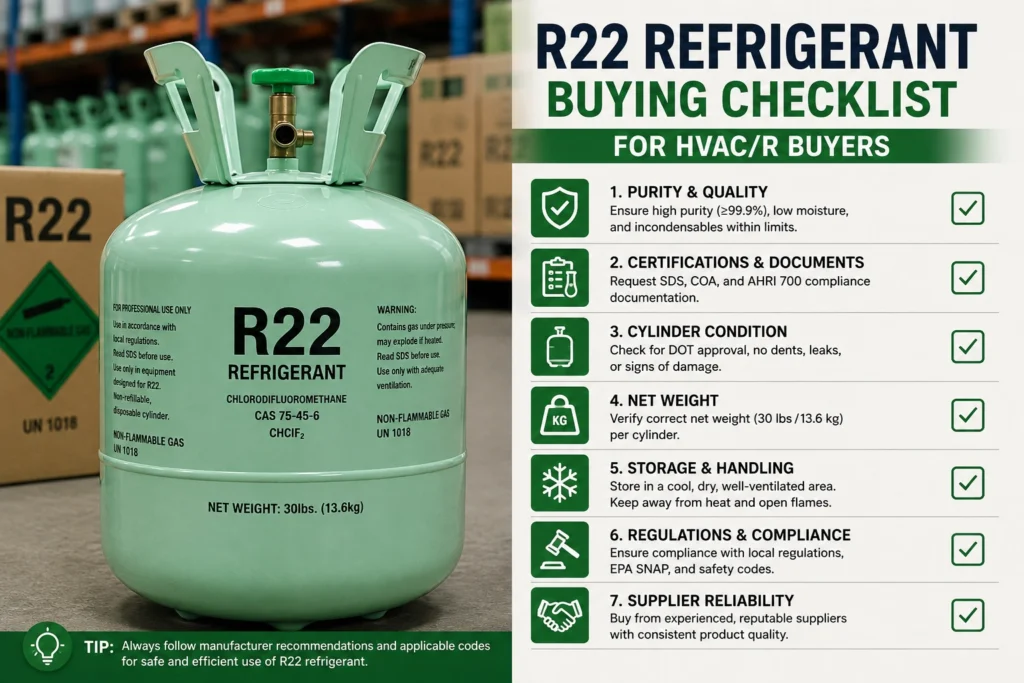
16. R22 Refrigerant Buying Checklist
Before confirming an order, verify:
- ✓ Equipment compatibility
- ✓ Intended application
- ✓ U.S. purchasing requirements
- ✓ Refrigerant source
- ✓ Product quality
- ✓ COA
- ✓ SDS
- ✓ Batch or lot information
- ✓ Cylinder condition
- ✓ Cylinder size
- ✓ Net refrigerant weight
- ✓ Available quantity
- ✓ Supplier information
- ✓ Warehouse location
- ✓ Shipping requirements
- ✓ Total delivered cost
Frequently Asked Questions About R22 Refrigerant
Is R22 Refrigerant Still Legal in the United States?
Existing R22 systems can continue to be operated and serviced. The United States ended production and import of HCFC-22 in 2020, but recovered and reclaimed R22 and HCFC-22 produced before 2020 can continue to support existing equipment.
Can Anyone Buy R22 Refrigerant?
No. For stationary refrigeration and air-conditioning equipment, Section 608 certification requirements and EPA refrigerant sales restrictions apply, subject to specified exceptions and authorized-purchaser provisions.
Is R22 Refrigerant Still Being Produced in the United States?
U.S. production and import of HCFC-22 ended in 2020. The current servicing market therefore relies on sources including reclaimed R22 and previously produced material.
What Does AHRI Standard 700 Mean for R22?
AHRI Standard 700 includes R22 within its scope and establishes purity specifications and associated test methods for refrigerants regardless of source.
Is an R22 COA the Same as an SDS?
No. A COA generally relates to product or batch quality information, while an SDS primarily addresses hazards, handling, storage, safety, and related information.
Can R22 Be Replaced With Another Refrigerant?
Alternatives exist, but there is no universal replacement appropriate for every R22 system. Equipment design, lubricant, components, performance requirements, manufacturer guidance, end use, and applicable regulations should be reviewed before a retrofit.
What Should I Check Before Buying R22 Refrigerant?
At minimum, verify product identity, source, cylinder size, net weight, cylinder condition, SDS, COA when applicable, supplier information, available quantity, and shipping terms.
Final Thoughts
Buying R22 refrigerant today requires more due diligence than simply finding the lowest cylinder price.
Professional HVAC/R buyers should evaluate:
Equipment Compatibility + R22 Source + U.S. Purchasing Requirements + Refrigerant Quality + SDS & COA + Cylinder Condition + Supplier Reliability + Total Delivered Cost
The U.S. R22 phaseout changed how the market is supplied, but it did not prohibit continued servicing of existing R22 systems.
For contractors, wholesalers, distributors, commercial refrigeration companies, and facility operators, careful supplier verification and documentation review can help reduce purchasing risk.
Request an R22 Refrigerant Quote
Looking for R22 refrigerant for HVAC/R service, wholesale distribution, commercial refrigeration, or other professional applications?
Contact our team to discuss:
- R22 cylinder size
- Current availability
- Quantity requirements
- SDS and COA documentation
- Wholesale quantities
- Warehouse location
- Shipping options